





Unmatched support.Thank you for making it simple.


Video lectures
Mock exam questions
Exam preparation highlights
Ask the trainer where really responding back to any questions you have.
Much appreciation
Mr karim Mansour

Highly Recommended

The video lessons, summaries, and mock exams cover all the key concepts from the study materials and really helped me focus on what matters most. You also get valuable insights into the real exam structure and question style, which makes a big difference.
Special thanks to Dr. Karim Mansour – your support and clear explanations made the entire process much easier. Thanks again!
What is included
- Recorded video lectures covering every element of the syllabus, chapter by chapter
- Chapter summary slides and study notes for revision
- Multiple-choice practice questions designed around the CISI examination format, organised by chapter
- An Ask the Trainer section for questions on the material
- Three months access to the premium job vacancies in the UK, the GCC, Egypt and India
- We DON’T offer live classes.
- Exam fees are NOT included in the course price. They are paid separately to CISI.
- Official CISI study book is NOT included in the course price. CISI doesn’t allow us to distribute it. You can get it from them when you book the exam.
The practice questions are written by Tadawul Academy for preparation. CISI doesn’t publish official exam questions or past papers.
Every subscription includes 3 months access to our banking and finance job listings. Hundreds of current openings in corporate finance, investment banking, M&A, valuation and private equity across London, Dubai, Abu Dhabi, Saudi Arabia, Qatar, Egypt and India — including roles that ask for CISI qualifications by name. No other CISI training provider gives you this.
The CISI Corporate Finance Technical Foundations exam is 50 multiple-choice questions in one hour, and 34 of the 50 marks sit in the first three elements: quantitative analysis, capital structure and business valuations. Element 1 carries 15 on its own. On the sample paper CISI publishes for this unit, thirteen of the fifty questions require you to work out a number. This course covers all five elements while putting your study time where the marks and the calculations are.
Study at your own pace alongside the current CISI workbook, then use the practice questions to check whether you can apply the methods under exam conditions rather than only recognise them on the page.
Try Two Chapters Free → Create an account on our e-learning portal and see the lectures, slides and questions before you buy.
- 95% pass rate among our students.
- Over 1,000 five-star Google reviews.
- Fully recorded and self-paced — start as soon as your account is activated and study at any hour.
The CISI examination is booked and paid for separately, directly with the CISI. The price on this page covers the Tadawul Academy preparation course only. Current CISI examination fees are set out below.
Who this Corporate Finance Technical Foundations course is for
This unit suits people who need a working command of how companies are analysed, valued, financed and bought or sold:
- Corporate finance, investment banking and mergers-and-acquisitions analysts
- Valuation, transaction-services and financial due-diligence staff
- Private equity, venture capital and leveraged-finance professionals
- Equity-capital-markets and debt-capital-markets staff
- Accountants and company finance staff moving into transaction or advisory work
- Anyone taking the technical unit of the CISI Certificate in Corporate Finance
There are no entry requirements. What the paper assumes is that you can use a calculator accurately with percentages, ratios, discounting and financial-statement figures — CISI states this in the objectives section of the syllabus, which it does not do for most of its Level 3 units. Check CISI’s current calculator rules before you book.
What passing Corporate Finance Technical Foundations gives you
Read this before you book. Corporate Finance Technical Foundations is Unit 2 of the CISI Certificate in Corporate Finance. Passing it completes the technical unit; it does not by itself award the full Certificate. You also need to satisfy the Corporate Finance Regulation unit requirement — a separate exam with its own workbook and fee.
The completed Certificate is recognised by Ofqual at Level 3, sits at level 4 on the European Qualifications Framework and has a total qualification time of 162 hours. Offered jointly with the ICAEW, it appears in the FCA’s appropriate qualification tables for regulated activity 8, entitles you to apply for CISI Associate membership and the letters ACSI, and leads on to the ICAEW/CISI Diploma in Corporate Finance, a separate Level 6 qualification. That FCA recognition belongs to the completed Certificate, not to one unit of it. CISI Student membership is free while you study.
What the CISI Corporate Finance Technical Foundations exam covers
The current specification is syllabus version 20, effective from 11 April 2026. Five elements, with the number of questions each contributes:
| Element | Questions | What to prepare for |
|---|---|---|
| 1. Quantitative Analysis for Corporate Finance | 15 | IFRS and US GAAP context, financial statements and group accounts, IAS 7 cash flows, free cash flow, EBITDA, NOPAT and CFADS, the margin, return, liquidity, gearing and investor ratios, and variance, standard deviation and covariance of returns. |
| 2. Capital Structure | 11 | Equity, debt ranking and security, bonds, loans and alternative financing, coupon, current yield and yield to maturity, the cost of debt, bond present value, CAPM and the weighted average cost of capital. |
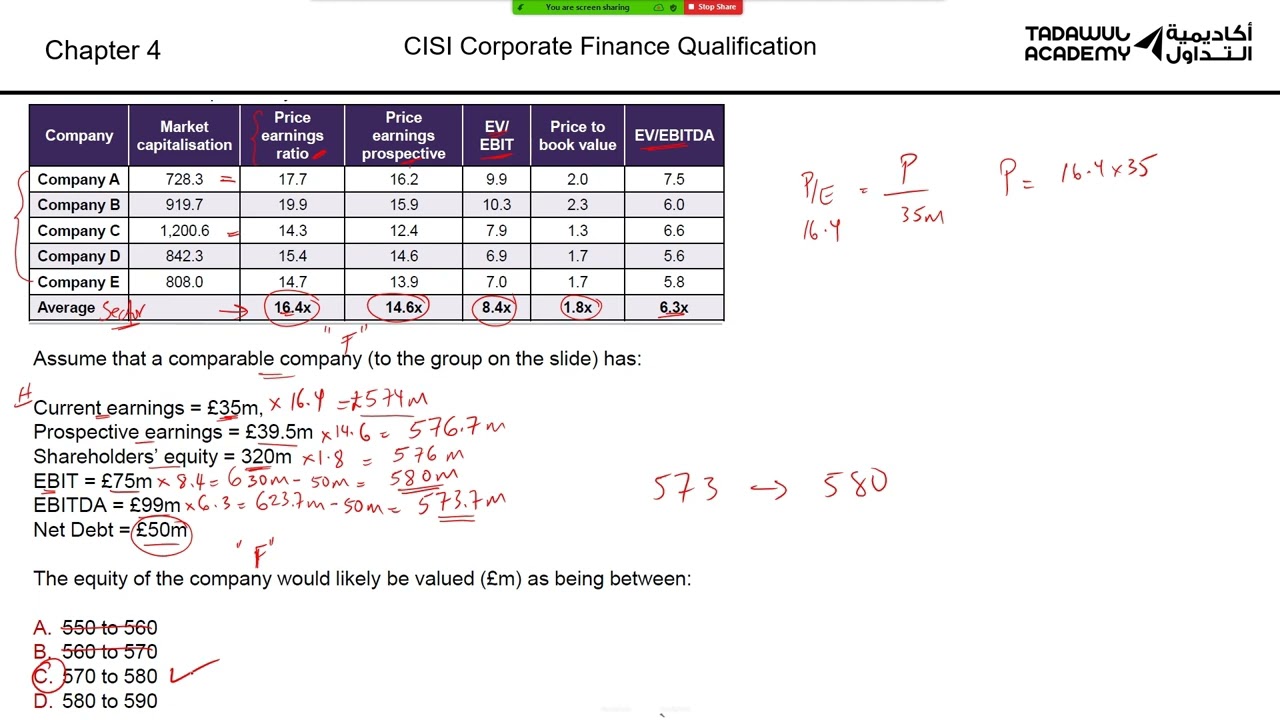
| 3. Business Valuations | 8 | Equity against enterprise value; earnings, market, transaction, break-up, asset, cash-flow and dividend approaches; P/E and price to book, NPV, IRR and the dividend discount model. |
| 4. Corporate Transactions | 11 | Acquisitions and disposals, private-equity and leveraged deals, MBO, MBI, LBO, BIMBO, IBO and public-to-private structures, the deal vocabulary from ratchets to carried interest, IPO advisers, due diligence, book-building, secondary offerings and rights issues. |
| 5. Corporate Finance Documentation | 5 | Confidentiality and engagement documents, warranties, indemnities and disclosure, shareholders’ agreements, heads of terms, sale-and-purchase agreements, term sheets, loan and intercreditor agreements and verification notes. |
An element can move by up to two questions between papers, but the shape holds: Elements 1, 2 and 3 are 34 of the 50 marks, and they carry the calculations that the transaction questions in Element 4 assume you can already perform. Element 5 is the mirror image — five marks, and the longest list of named documents in the syllabus. Learn it, but learn it last.
The calculation load is what catches people out. On CISI’s published sample paper, thirteen of the fifty questions want a computed answer: standard deviation and a correlation coefficient, an expected return from probabilities, a dividend yield, return on capital employed, a theoretical ex-rights price, the present value of a three-year bond, a Gordon growth valuation, a P/E valuation carrying a liquidity discount, and a terminal value from free cash flow and WACC. The syllabus adds CFADS, the cost of debt, CAPM, WACC, NPV and IRR. You have 72 seconds a question, so practise the whole process — identify the method, select the data, calculate, sense-check — not just the formula.
View the official CISI Certificate in Corporate Finance page, download the official version 20 syllabus or download CISI’s free sample paper. CISI publishes amendments in its Candidate Update area between syllabus editions, so check it before you sit.
Corporate Finance Technical Foundations exam format
| Questions | 50 multiple choice |
|---|---|
| Duration | 1 hour |
| Pass mark | 70% — 35 correct out of 50 scored questions |
| Study time | 80 hours for this unit, CISI’s average estimate; total qualification time for the two-unit Certificate is 162 hours |
| Delivery | Computer-based test, available on demand |
| Where | CISI’s global test-centre network, or online by remote invigilation where available |
| Trial questions | Up to 10% extra unscored questions may appear. They are not identified, do not count towards your result, and come with proportionately more time. |
| Results | Available in MyCISI within 24 working hours, provisional for five working days |
| Resits | Up to six attempts at the same subject in any rolling 12-month period. After three attempts within that period, a six-week rest period applies, counted from the third sitting. |
The resit limit runs over a rolling 12 months, not a calendar year. An employer can ask CISI for a one-off waiver of the six-week rest period for a fourth attempt; if that attempt is unsuccessful, the rest period applies and no further waiver is granted.
What the CISI Corporate Finance Technical Foundations exam costs
These are CISI’s fees, separate from the price of this Tadawul Academy course. The figures below come from the CISI price list covering 1 April 2026 to 31 March 2027, checked 4 August 2026.
Booking in the UK
- Exam: £245
- Workbook, mandatory with the booking: £105
- Exam, workbook and Revision Express together: £365
Booking internationally
- First sitting: £365, including the workbook and Revision Express access where available
- Resit within the same syllabus version: £245
- Some countries add a local invigilation fee
Other CISI fees
- Qualification Registration Fee: £68, paid once when you begin your first CISI qualification
- Revision Express bought separately: £45
- Performance Review after a failed attempt: £40, and free after three failures of the same subject
Both units are priced identically, and CISI publishes a combined figure for the Certificate: £490 in exam fees and £210 in workbooks. Budget for that at the outset if the Certificate, rather than this single unit, is what you are after.
A Performance Review shows your score element by element — where one element carries 15 marks and another five, that is the difference between revising everything again and revising the part that cost you the pass. CISI reviews prices annually, so confirm them on the current CISI price list before booking.
How to plan your Corporate Finance Technical Foundations study
CISI estimates an average of 80 study hours for this unit. Two schedules that reach it:
- Eight weeks at around 10 hours a week
- Twelve weeks at around 6–7 hours a week
These are Tadawul Academy suggestions, not CISI rules. Organise your time by exam weight and dependency:
- Start with Element 1. Its 15 marks supply the accounting and numerical base for everything after it.
- Take Elements 2 and 3 together. Nineteen marks, and one formula sheet: cost of debt, bond present value, CAPM, WACC, enterprise and equity value, P/E and price to book, NPV, IRR and the dividend models.
- Move to Element 4. Eleven marks connecting those numbers to acquisitions, private-equity structures, IPOs and secondary offerings. Add the theoretical ex-rights price to the sheet.
- Finish with Element 5, five marks of recall best left close to the exam, then mixed timed practice and back to any element scoring below 70%.
Begin practice questions after Element 1 rather than waiting until you have covered the whole workbook; answering them early shows which formulae have not stuck while there is time to drill them. Sit CISI’s free sample paper under timed conditions before you book — fifty questions in a strict hour tells you whether your calculations are quick enough. Book once you are consistently clearing 80% on mixed, timed sets.
Using this course with the CISI workbook
The current CISI workbook is the definitive examination text and the paper is written from it. Tadawul Academy adds explanations, revision slides, calculation walkthroughs, practice questions and trainer support so you can identify where your method breaks down.
- Watch the lecture for the chapter.
- Read the matching workbook section and work through its examples.
- Review the chapter summary slides and update your formula sheet.
- Answer that chapter’s practice questions without looking back at the material.
- Redo every calculation you answered incorrectly or guessed until you can reproduce the method unprompted.
At Level 3 you have to apply what the workbook explains to situations it does not spell out, and one question can draw on several parts of it: a valuation can hand you a P/E ratio from Element 1, a discount from Element 3 and a tax rate that turns out to be irrelevant, all in three lines. Practice shows whether you can use the material, not merely recognise it.
Before you enrol
- We do not run classroom training or live online sessions. This is a self-paced e-learning package of recorded video lectures, study notes and practice exams.
- You can create a free account on our e-learning portal and try two chapters before buying.
- After you order, we activate your account and email confirmation within a few hours. Please check that your email address is correct when you place the order.
- When your access expires, place a new order here to extend it.
- You need the current CISI Corporate Finance Technical Foundations workbook. We are not permitted to supply it. CISI provides it under its mandatory workbook policy when you book the exam; format and delivery arrangements differ between UK and international bookings, so confirm yours with CISI when you book.
Book the Corporate Finance Technical Foundations examination with CISI
Frequently asked questions
Do I need the CISI workbook as well as this course?
Yes. The workbook is the official examination text and CISI requires the current version with the booking where available. This course adds video explanations, revision material, worked methods, practice questions and trainer support.
How much does the CISI Corporate Finance Technical Foundations exam cost?
In the UK, the exam is £245 and the workbook £105, or £365 for both with Revision Express. An international first sitting is £365 with the workbook included; a same-version resit is £245. Add the one-off £68 registration fee for your first CISI qualification, and check whether a local invigilation fee applies where you sit. For both units of the Certificate, CISI’s published total is £490 in exam fees and £210 in workbooks. Figures cover 1 April 2026 to 31 March 2027.
Are there mock exams and practice questions?
The course includes multiple-choice practice questions written around the CISI exam format, organised by chapter so you can test each element as you finish it and practise working within the one-hour limit. They are Tadawul Academy questions, not live CISI questions.
Are there past papers or an official sample paper?
CISI does not publish past papers, but for this unit it publishes a free 50-question sample paper whose answer key maps every question back to the syllabus objective it tests. Sit it in a strict hour, then use those references to find which sub-element each mistake came from. Check the version on its front page matches the syllabus you are studying, and treat any other PDF of “real” questions circulating online as unofficial.
Is the exam heavily mathematical?
Yes. It includes ratios, statistics, bond valuation, CAPM, WACC, enterprise and equity value, multiples, discounted cash flow, NPV, IRR, dividend valuation and rights issues. Practise with a calculator throughout, and check CISI’s current calculator rules before you book.
Is this the full Level 3 Certificate in Corporate Finance, or the Diploma?
Neither. This is Unit 2 of the Certificate; you must also meet the Corporate Finance Regulation unit requirement to earn the complete CISI Level 3 Certificate in Corporate Finance. Associate membership and the FCA appropriate-qualification recognition apply to the completed Certificate, not to this technical unit alone. The ICAEW/CISI Diploma in Corporate Finance is a further Level 6 qualification taken afterwards — if you searched for the Diploma and landed here, this is the stage that comes first.
How long does preparation take?
CISI estimates 80 hours. Eight weeks at 10 hours, or twelve at 6–7, are workable examples. Candidates new to bond pricing, CAPM, WACC and valuation usually need more calculation practice than they planned for.
Does this course include live classes?
No. Everything is recorded and self-paced. Questions about the material can be submitted through the Ask the Trainer section for a written response.
How quickly is my account activated?
Within a few hours of your order, and we email you when activation is complete. A mistyped email address at checkout is the most common cause of delay.
What happens if I fail, and how many resits am I allowed?
You may attempt the same subject up to six times in any rolling 12-month period. A six-week rest period applies after a third attempt within that period, unless an employer obtains the one-off waiver available under CISI policy. A same-version international resit is £245. After three failures of the same subject, the CISI Performance Review is free and shows your result element by element.
Are the banking and finance job listings really included?
Yes, at no extra cost, for three months from activation. They include current corporate finance, investment banking, valuation, private-equity and related finance vacancies across the UK, Dubai, Abu Dhabi, Saudi Arabia, Qatar, Egypt and India, with CISI qualifications named in the requirements for many of the analyst and advisory roles.
NEED HELP?
Still Have a Question?
If you have read the course information and still need help, send us a WhatsApp message.
Free Videos From Our YouTube Channel




Katya Novikov –
This was exactly what I needed. The difficult topics finally started to click. Would recommend it to anyone studying alone.
Riya Patel –
Very useful from start to finish. Everything was laid out in a way that made sense. I used it mostly in the evenings. Definitely worth it.
Emilia Herrera –
The course kept me focused on the important areas. It helped me finish the syllabus without rushing. Thanks to the team.
Dev Mehta –
This worked very well for me. The material was easy to navigate and pick up again later. I passed on my first attempt.
Kwame Udo –
Good value for the study support. I had to replay a few explanations before they made sense. Still, the videos made the difficult chapters much easier to understand.